
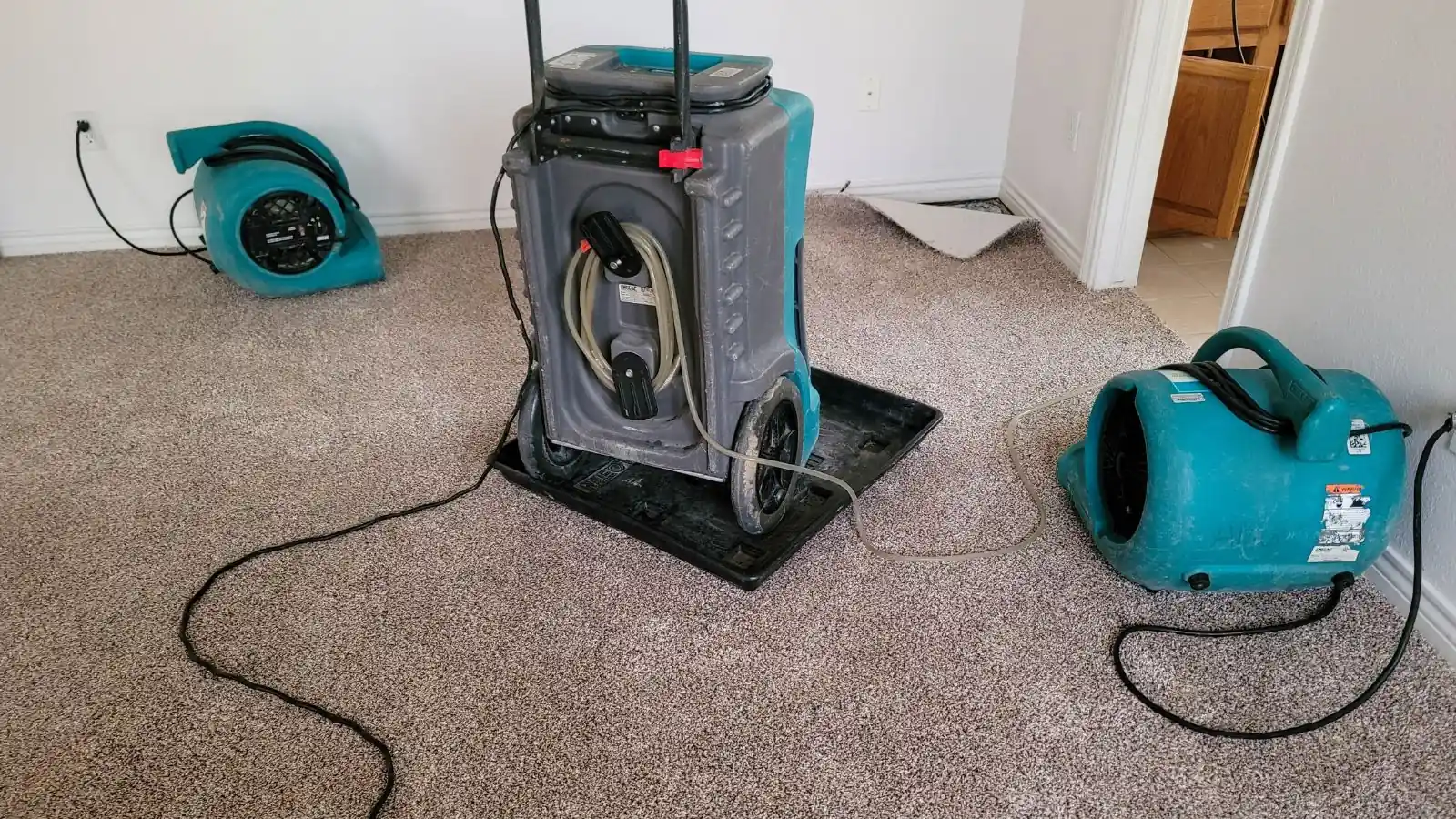
Nobody can quote a fair price for water damage without seeing it, and any number given over the phone is a guess. What you can do is understand what drives the price, so you can read a written scope and ask the right questions. The crew explains scope and price before any work begins.
What moves the price
| Factor | Why it matters | Effect |
|---|---|---|
| Water category | Contaminated water needs more removal and sanitizing | Higher with Category 2 and 3 |
| Area affected | More square footage means more equipment and labor | Scales with size |
| Materials | Some dry, some must be replaced | Varies widely |
| Time before action | Water left longer spreads and soaks deeper | Higher with delay |
| Drying days | Equipment and monitoring run daily | Scales with duration |
| Access | Crawl spaces, tight rooms and upper floors take more effort | Higher where access is hard |
A small clean leak on a hard floor, caught right away, is a short job. A slow leak behind a wall that has soaked insulation and framing is a long one. The difference is rarely the size of the leak, but how long the water had to travel.
The parts of a typical bill
- Emergency response and assessment
- Water extraction
- Removal of materials that cannot be dried
- Equipment days for air movers and dehumidifiers
- Monitoring and documentation
- Cleaning and sanitizing where needed
- Disposal of removed material
Rebuilding is separate. Replacing drywall, trim, flooring and paint is repair work, and it is often quoted apart from mitigation.
Need an on-site assessment?
Call the line and ask how scope and price are explained.
How to read a written scope
- Check that each room and material is listed
- Look at what is removed and what is dried, and the reason for each
- See how many equipment days are planned and how they will be monitored
- Ask what happens to the price if readings show more water than expected
- Ask for the document that goes to your insurer
A good scope can be explained in plain words. If the company cannot say why something is on the list, ask until it can.
Insurance and the deductible
Many owners ask insurers to pay for sudden water losses, and the deductible is the amount you pay first. If the loss is small, it may fall under the deductible. The question of whether to file is covered in a separate guide on this site, and your agent can explain how your policy works.
A restoration company can supply documentation, and it cannot promise what an insurer will pay. Be careful of any company that says it will handle the claim and the price will be whatever insurance allows.
Ways to avoid surprises
- Get the scope and price explained before work starts
- Ask what could change the scope, and how you will be told
- Ask for daily readings and a final record
- Keep photos and notes of what was removed
- Do not agree to extra work without a written change
Early action is the biggest lever you have. Stopping the source and starting extraction quickly keeps the affected area small, and a small area costs less to dry.
Comparing two scopes
If you get two written scopes, compare what is in them, not only the totals. One may list removal of wet drywall while the other plans to dry it in place. One may plan five equipment days and another eight. The difference may be a different reading of the loss, so ask each company to explain its choice.
A lower total is not always less costly in the end. A scope that leaves out monitoring or removal that the loss needs can lead to change orders later. Check that both scopes cover the same rooms, the same materials and the same documentation.
Questions about payment
- When is payment due, and is a deposit required
- Will the company bill the insurer directly, and what happens if the insurer pays less
- Which items might lead to extra charges
- What happens if you decide to stop work partway
- Who is responsible for the rebuild stage
Get the answers in writing. A written answer protects both sides when memories differ.
Why early action lowers the total
Water that is removed quickly stays in a small area. Water left for days soaks into framing, spreads under floors and carries contamination into more materials. The same leak can be a small job or a very large one, depending on how soon extraction began.
That is the main reason to call right away and to shut off the source. You are not buying a promise of a lower price. You are limiting how much there is to dry, and that is what drives most of a bill.
What is not on the bill
Some costs sit outside a restoration bill. Replacement of personal belongings, hotel stays, meals away from home and the rebuild stage are often handled separately. Ask your insurer which of these your policy covers and what it needs to see.
Plumbing repair is also a separate cost. A restoration company dries the structure, and a plumber fixes the pipe or the fixture. Owners sometimes assume one bill covers both, so be clear about who is doing what.
Finally, there may be costs for permits, inspections or specialist testing if the loss involves contamination or building systems. Ask early so these do not surprise you.
Cost questions around Braselton
Permits for rebuilding depend on the office that covers your address, and fees and rules differ between Braselton, Hoschton, Oakwood and the counties around them. Ask the building office what a given repair needs, since a permit can add time and cost to the rebuild stage.
Single-family houses dominate Braselton's housing, and many have larger floor plans with finished lower levels. Larger areas mean more equipment days, which is one reason jobs in Hoschton and Pendergrass differ from small apartment losses.
For the first step on any loss, see water extraction, and for how a company should measure the end of the job, see structural drying.
Questions people ask
How much does water damage restoration cost?
It depends on the water category, the area, the materials and the drying days. A written scope after an on-site assessment gives the figure for your house.
Why can nobody quote a price by phone?
The price depends on what is wet and how far it spread, and that needs an assessment.
Is rebuilding included in the first price?
Usually not. Mitigation and rebuilding are often separate scopes.
Does insurance pay all of it?
That depends on your policy, the cause and the deductible. Ask your insurer.